Despina
Despina can be reached in two ways: by ship or by camel. The city displays one face to the traveler arriving overland and a different one to him who arrives by sea.
When the camel driver sees, at the horizon of the tableland, the pinnacles of the skyscrapers come into view, the radar antennae, the white and red wind-socks flapping, the chimneys belching smoke, he thinks of a ship; he knows it is a city, but he thinks of it as a vessel that will take him away from the desert, a windjammer about to cast off, with the breeze already swelling the sails, not yet unfurled, or a steamboat with its boiler vibrating in the iron keel; and he thinks of all the ports, the foreign merchandise the cranes unload on the docks, the taverns where crews of different flags break bottles over one another’s heads, the lighted, ground-floor windows, each with a woman combing her hair.
In the coastline’s haze, the sailor discerns the form of a camel’s withers, an embroidered saddle with glittering fringe between two spotted humps, advancing and swaying; he knows it is a city, but he thinks of it as a camel from whose pack hang wine-skins and bags of candied fruit, date wine, tobacco leaves, and already he sees himself at the head of a long caravan taking him away from the desert of the sea, toward oases of fresh water in the palm trees’ jagged shade, toward palaces of thick, whitewashed walls, tiled courts where girls are dancing barefoot, moving their arms, half-hidden by their veils, and half-revealed.
Each city receives its form from the desert it opposes; and so the camel driver and the sailor see Despina, a border city between two deserts.
Notes
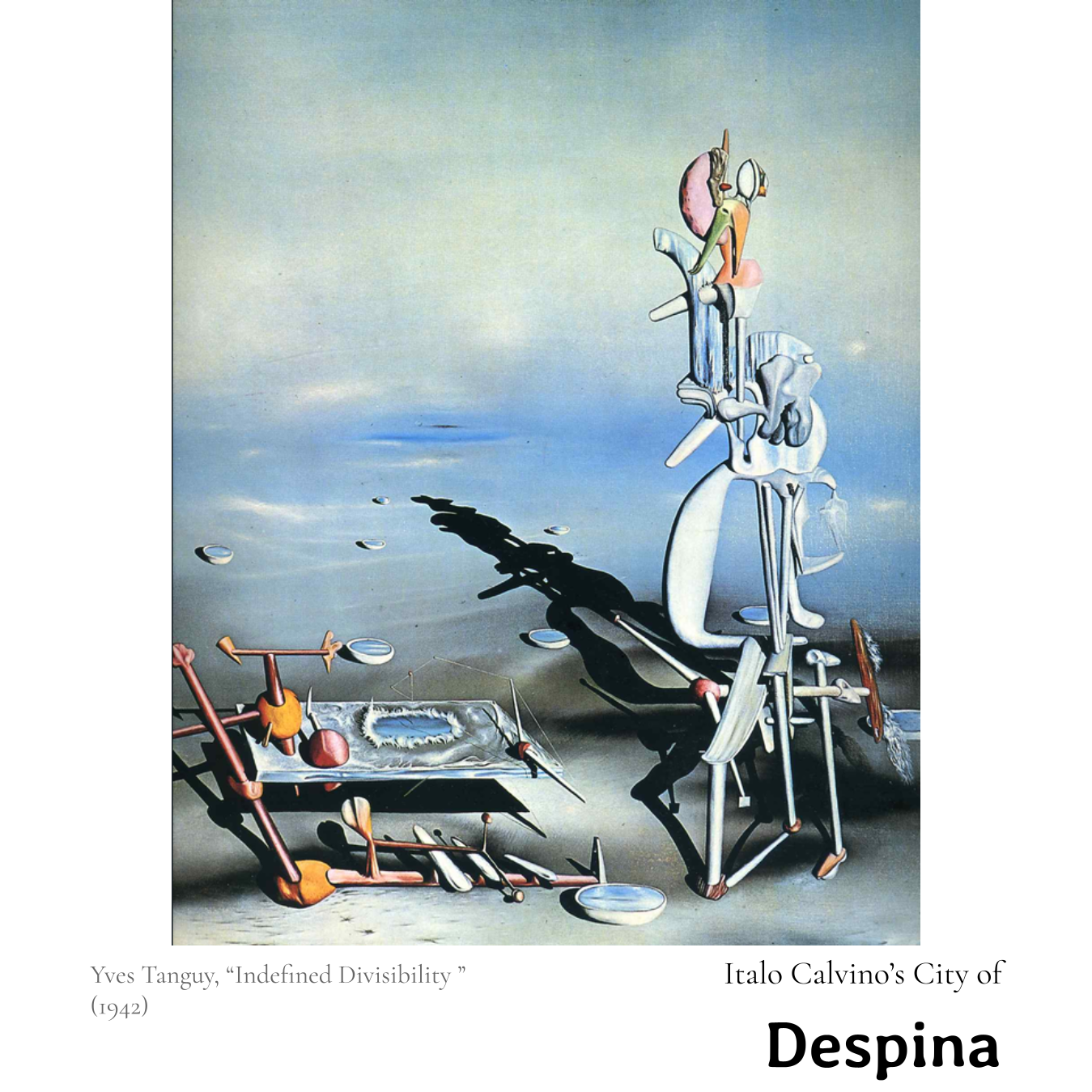
In Italo Calvino’s Invisible Cities, Despina is a city that changes depending on who approaches it. To the traveller crossing the desert, it resembles a ship promising escape across the sea. To the sailor arriving from the water, it appears as a camel offering passage into the desert. The city remains the same, yet each traveller encounters a different possibility shaped by their own longing. Yves Tanguy’s Indefinite Divisibility (1942) inhabits a similar uncertainty. Its strange, almost architectural forms resist recognition, shifting between objects, structures, and imagined beings. We search for something familiar within them, revealing how perception is shaped by what we already carry within ourselves. For November’s The Mask, Despina reminds us that appearances belong as much to the observer as to the observed. We see others through our desires, memories, and expectations, just as they see us through theirs. Perhaps every identity is partly a reflection of someone else's longing, and every city wears a different face for those who arrive. #ItaloCalvino #InvisibleCities #YvesTanguy #Surrealism #LiteraryArt