Leonia
The city of Leonia refashions itself every day: every morning the people wake between fresh sheets, wash with just-unwrapped cakes of soap, wear brand-new clothing, take from the latest model refrigerator still unopened tins, listening to the last-minute jingles from the most up-to-date radio.
On the sidewalks, encased in spotless plastic bags, the remains of yesterday's Leonia await the garbage truck. Not only squeezed tubes of toothpaste, blown-out light bulbs, newspapers, containers, wrappings, but also boilers, encyclopedias, pianos, procelain dinner services. It is not so much by the things that each day are manufactured, sold, bought that you can measure Leonia's opulence, but rather by the things that each day are thrown out to make room for the new. So you begin to wonder if Leonia's true passion is really, as they say, the enjoyment of new and different things, and not, instead, the joy of expelling, discarding, cleansing itself of a recurrent impurity. The fact is that street cleaners are welcomed like angels, and their task of removing the residue of yesterday's existence is surrounded by a respectful silence, like a ritual that inspires devotion, perhaps only because once things have been cast off nobody wants to have to think about them further.
Nobody wonders where, each day, they carry their load of refuse. Outside the city, surely; but each year the city expands, and the street cleaners have to fall farther back. The bulk of the out Bow increases and the piles rise higher, become stratified, extend over a wider perimeter. Besides, the more Leonia's talent for making new materials excels, the more the rubbish improves in quality, resists time, the elements, fermentations, combustions. A fortress of indestructible leftovers surrounds Leonia, dominating it on every side, like a chain of mountains.
This is the result: the more Leonia expels goods, the more it accumulates them; the scales of its past are soldered into a cuirass that cannot be removed. As the city is renewed each day, it preserves all of itself in its only definitive form: yesterday's sweepings piled up on the sweepings of the day before yesterday and of all its days and years and decades.
Leonia's rubbish little by little would invade the world, if, from beyond the final crest of its boundless rubbish heap, the street cleaners of other cities were not pressing, also pushing mountains of refuse in front of themselves. Perhaps the whole world, beyond Leonia's boundaries, is covered by craters of rubbish, each surrounding a metropolis in constant eruption. The boundaries between the alien, hostile cities are infected ramparts where the detritus of both support each other, overlap, mingle.
The greater its height grows, the more the danger of a landslide looms: a tin can, an old tire, an unraveled wine Bask, if it rolls toward Leonia, is enough to bring with it an avalanche of unmated shoes, calendars of bygone years, withered Bowers, submerging the city in its own past, which it had tried in vain to reject, mingling with the past of the neighboring cities, finally clean. A cataclysm will Batten the sordid mountain range, canceling every trace of the metropolis always dressed in new clothes. In the nearby cities they are all ready, waiting with bulldozers to Batten the terrain, to push into the new territory, expand, and drive the new street cleaners still farther out.
Notes
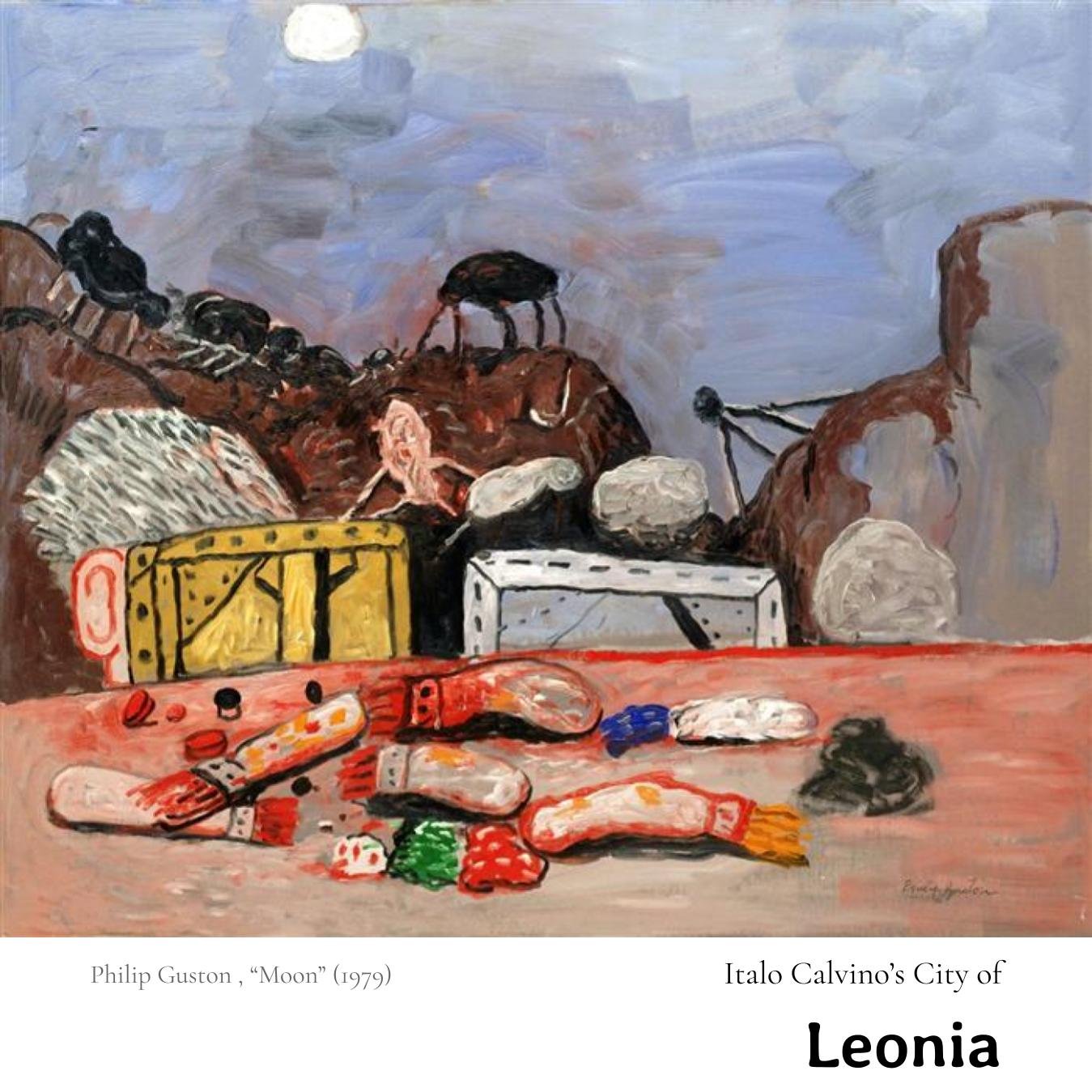
The Calvino city that best represents The Jacaranda’s theme for August (Feast) is Leonia. A city built not upon the modest preservation of what it owns, but reborn fresh every single morning in pristine, factory-sealed luxury, leaving yesterday’s entire existence packaged and discarded outside its borders. The inhabitants do not live in a modest, circular economy; they live in a hyper-accelerated engine of consumption, where every unwrapped commodity and pristine surface is a fleeting monument to the art of total renewal. In Leonia, the feast is entirely mechanical. To walk its spotless streets is to participate in an insatiable, daily ritual of surplus, gliding over an ever-accumulating ring of refuse that slowly swells into an avalanche surrounding the city walls. Awareness in Leonia is not a quiet moment of restraint, but a confrontation with the objective drive of appetite: the realization that our drive to consume operates through an unbridgeable lack, where every new item acquired is merely a screen covering the mountain of discarded waste that sustains the illusion of clean, unbroken luxury. Featured alongside it is Philip Guston’s Moon (1979). Guston uses heavy, raw impasto and a stark, bruised palette to conjure a landscape littered with raw, discarded forms under the cold, unblinking glare of a solitary moon. In these late Neo-Expressionist canvases, the thick, visceral shapes do not depict ordinary objects; they embody the heavy, suffocating weight of material residue, mimicking the dark, unglamorous underside of Leonia’s daily feast. The stark, brooding horizon and tangled forms feel less like a peaceful nightscape and more like a monuments field of consumer hangover. A visual architecture of excess that forces the viewer to see the landscape as an inescapable mirror of our own endless appetites. Guston’s raw, unflinching lens echoes Leonia’s contradictory logic. The thick, tactile strokes and cold, nocturnal light create a sanctuary of brutal honesty where the "I" is forced to gaze directly at the debris left behind after the banquet is cleared away. It is the heavy, rhythmic pulse of a city that exists only through its relentless rejection of yesterday, a sun-drenched yet garbage-encircled stage that reminds us that to feast without limits is to find oneself ultimately surrounded by the towering ghosts of what we have consumed. . #italocalvino #neoexpressionism #philipguston #invisiblecities #august